

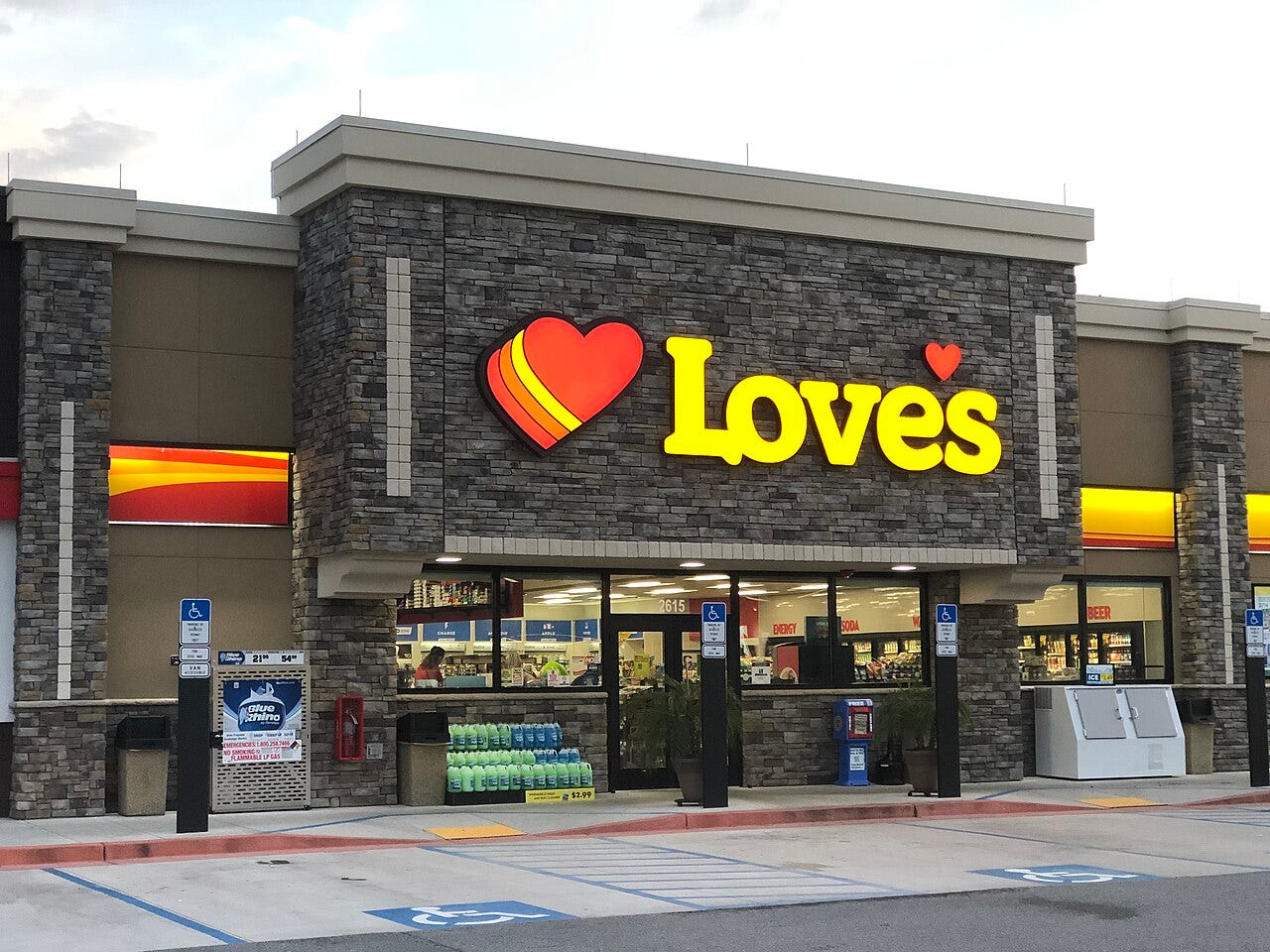
This thanksgiving trip took us from Austin to Denver. Usually, we plan our stops around Costco, but on this route through the Texas panhandle, there was almost nothing—except for Love’s Travel Stops.
Seeing so many of them sparked my curiosity. As investors and founders, we often look at high-tech moats, but Love’s offers a masterclass in business model evolution. It’s not just a “gas station”; it is a comprehensive service ecosystem for the logistics industry.
Here is the breakdown of an empire built on diesel and smart pivots.
1. The Origin Story: Spotting Opportunity in Failure
Love’s is fully owned by the Love family (founded by Tom Love). It started in Watonga, Oklahoma, when Tom leased an abandoned service station to create “Musket Station.”
The First Pivot (1970s): Tom boldly introduced Self-Service Gasoline. This reduced labor costs and allowed him to sell fuel at competitive prices, quickly capturing market share in price-sensitive rural areas.
The C-Store Model: He opened a site in Guymon, Oklahoma, that combined self-service gas with a “Mini Stop.” This was the prototype for the modern Convenience Store model: use low-margin fuel as a Loss Leader (traffic driver) to convert customers into high-margin retail buyers (cigarettes, drinks, food).
2. Riding the Macro Tailwind
Two major events in 1980 supercharged their growth:
The completion of the Interstate Highway System.
The Motor Carrier Act of 1980, which deregulated the trucking industry.
This created an explosion in long-haul trucking. In 1981, Love’s opened its first true “Travel Stop” in Amarillo, Texas. They shifted their target persona from “general drivers” to “professional truckers.”
Service Upgrade: 24/7 operations, showers, and massive truck parking lots.
The Result: The company evolved from a “street-side convenience store” to a critical “transportation infrastructure provider.”
Today, they operate 640+ locations across 42 states and are a fixture on the Forbes list of America’s Largest Private Companies (2023 Revenue est. $45B - $60B, depending on oil prices).
3. The Moat: Vertical Integration & Closed-Loop Ecosystem
Love’s isn’t just selling gas; they are capturing value at every link in the chain. This is a classic “Closed-Loop Ecosystem”:
Musket Corporation (Trading): Their commodities trading and logistics arm. They handle fuel procurement, hedging, and wholesale, maximizing the Fuel Margin.
Gemini Motor Transport (Logistics): Their own fleet. They transport fuel from terminals to stations, ensuring supply chain stability and lowering logistics costs.
Speedco (Maintenance): On-site truck repair and tire services.
Factoring (Fintech): Financial services for trucking companies.
Furthermore, they have a Real Estate Moat. Acquiring large plots of land right off major highway exits (necessary for truck turning radiuses) involves high regulatory hurdles. It is incredibly difficult for new entrants to replicate their footprint.
The industry has three main players: Pilot Company (majority-owned by Berkshire Hathaway), Love’s, and TravelCenters of America (TA).
What fascinates me most is that Tom Love repeatedly rejected Wall Street’s IPO offers. He understood a fundamental truth that plagues many public tech companies today: Quarterly earnings pressure kills long-term vision.
By staying private, Love’s avoided the pressure to cut CapEx (Capital Expenditures) to please analysts. This allowed them to invest counter-cyclically—buying land and expanding when oil prices crashed or the economy dipped.
Takeaway
Tom Love’s journey—from an abandoned station to a multi-billion dollar empire—is a lesson in cash flow and customer retention. Every step he took addressed a core pain point:
“How do I get the people passing by to stop longer and spend more on my property?”
Whether you are building a SaaS platform or a hardware startup, the question remains the same.
How to Apply Tom Love’s Strategy, Spirit, and Opportunity Discovery in the Modern Era
Tom Love’s success was not built on “inventing new technologies,” but on “restructuring existing needs” and “extreme operational discipline.” In an era dominated by AI and digitization, studying his strategy is arguably even more valuable. He demonstrated how to mine immense profits from “unsexy” traditional industries by solving fundamental inefficiencies.
1. Opportunity Discovery: Identifying “Fragmentation & Friction”
Tom Love’s core insight was identifying a disconnect: fueling and shopping were separate activities (inefficiency), and the basic needs of truck drivers were being ignored.
How to apply this today:
Seek out “Forgotten Infrastructure”:
Tom Love’s Era: Gas stations were dirty, and no one cared about the driver’s experience.
Modern Era: Observe industries that are “essential but offer a terrible experience.” Examples include elderly care, blue-collar recruiting, waste management, and traditional logistics warehousing. These sectors are often low on digitization and high on fragmentation—ripe for consolidation and optimization.
Practice the “Bundling Strategy”:
The Love’s Model: Bundling “Fuel + Snacks + Showers + Parking.”
Modern Application: Consider what else your target audience needs immediately before or after completing a task.
Example: Modern gyms are no longer just about equipment; they bundle physical therapy, nutrition subscriptions, and social co-working spaces.
Focus on “Humanity in B2B”:
The Insight: Most saw truckers merely as “capacity”; Tom Love treated them as “people” (who need hot showers and hot food).
Modern Application: In SaaS or Enterprise Services, look beyond features to “emotional value.” Making a user’s workflow less stressful and more dignified is a powerful competitive moat.
2. Strategic Execution: From MVP to Ecosystem
Love’s was not built in a day. It started with leasing a single abandoned station.
How to apply this today:
Low-Cost Trial ( The MVP Mindset):
The Precedent: With only $5,000, Tom Love didn’t buy land; he leased an abandoned site.
Modern Application: Do not start with heavy CapEx or massive app development. Use existing tools (No-code, existing platforms) to test the business model. Only deploy significant capital once you have validated that “someone is willing to pay.”
The Courage for Vertical Integration:
The Precedent: Once scaled, Love’s integrated upstream (Musket for trading, Gemini for transport).
Modern Application: Many startups fail by relying too heavily on third-party platforms (e.g., Facebook Ads or Amazon Logistics). Learn from Love’s: once your core business is stable, gradually control your supply chain or own your data. That is where the margin lies.
Asset Duality:
The Precedent: Love’s appears to be retail, but fundamentally, it is a real estate business (controlling highway exits).
Modern Application: Consider if your business can accumulate “Digital Assets” or “Network Effects.” Build a community (digital real estate), not just a transactional product.
3. Entrepreneurial Spirit: Servant Leadership & “On-Site” Culture
Tom Love famously said: “We sell what everyone else sells (fuel, cola). Why should they choose us? Because of Clean Places and Friendly Faces.”
How to apply this today:
The “Clean Toilet” Philosophy:
The Habit: Even as a billionaire, Tom Love would inspect the restrooms during site visits. This represents an obsession with detail.
Modern Application: Whether in software or hardware, your “toilet” is your customer support response time, your UI/UX usability, and your refund process. These unglamorous details determine retention.
Contrarian Investing:
The Habit: The Love family historically purchased land during economic recessions when it was cheapest.
Modern Application: When the market is chasing a bubble (like a specific AI hype cycle), remain calm and preserve cash. When the market panics and crashes, that is your moment to acquire premium assets (talent, technology, user base).