Life
This week my wife and I went in for a dental checkup — our first time seeing a dentist here in the US — and it really hit home just how much more expensive dental work and extractions are than I’d expected. For the average person without coverage through an employer, a school, or their own extra insurance, one bad tooth can end up costing a small fortune.
The insurance companies here are making an absolute killing. What's interesting is that Delta Dental — the biggest pure-play dental insurer — isn't even publicly traded. Look closely at their business model: every dental plan comes with an "Annual Maximum" (usually only $1,000–$2,000 a year in payouts), plus long waiting periods and steep coinsurance percentages on the expensive procedures like extractions and implants. In other words, the insurer's downside risk is locked in — it's basically guaranteed profit. Honestly, it makes me want to invest in them myself (kidding).
This extraction bill also gave me a real, firsthand feel for the power of "claim caps" and "sky-high medical device pricing" in the US healthcare industry. Even though the pure-play dental insurers aren't publicly listed, that steady, non-negotiable demand is quietly feeding giants like Align (ALGN) and Henry Schein (HSIC) on the dental device and distribution side. Maybe this is another defensive sector — beyond semiconductors — with that "long runway, deep snow" quality worth keeping on our radar.
On the tech research side, I spent a good chunk of time getting my head around the technology behind Kimi 3 — dug through the company's old papers and read up on the founders' backgrounds. It was a week of deep, heads-down thinking. I've also been chewing on where the semiconductor cycle stands right now. The outlook is bright, but between the share-price swings and all the deleveraging, we're starting to see a lot of setups lately that we think are genuinely worth digging into and positioning around.
I'm really thankful that God kept our work, our lives, and our family safe and sound all week.
A Few Thoughts on Kimi 3
The short version: Kimi 3 changed the algorithm, and the real impact is on "cost per task," not the "model's benchmark score." In our own testing on the same task, Kimi 3 came out 2.3x cheaper than Anthropic Fable 5 — the trade-off being that it burns more tokens and runs slower. But since the unit price is only about a third, the total cost still wins. That makes it a good fit for scheduled, run-in-the-background jobs, not real-time conversation.
We think Kimi 3 saves memory, but that doesn't mean your overall memory usage drops. Kimi 3 mixes Kimi Delta Attention with traditional MLA at a 3:1 ratio, so it only saves up to 75% on the KV Cache part — the rest of the inference process still eats memory as usual. And since it burns twice the tokens, that doubled inference run needs the memory just the same.
Finally, Kimi 3 trains with MXFP4 rather than NVIDIA's NVFP4, which means future fine-tuning or the next generation isn't necessarily tied to NVIDIA chips — other ASICs are on the table.
What I Read in this week ?
Intel
Intel posted its strongest quarterly growth in 15 years: revenue of $16.1B, a beat (consensus $14.3B). The Q3 guide is even stronger — revenue of $16.3B (vs. consensus $15.1B), gross margin of 42%.
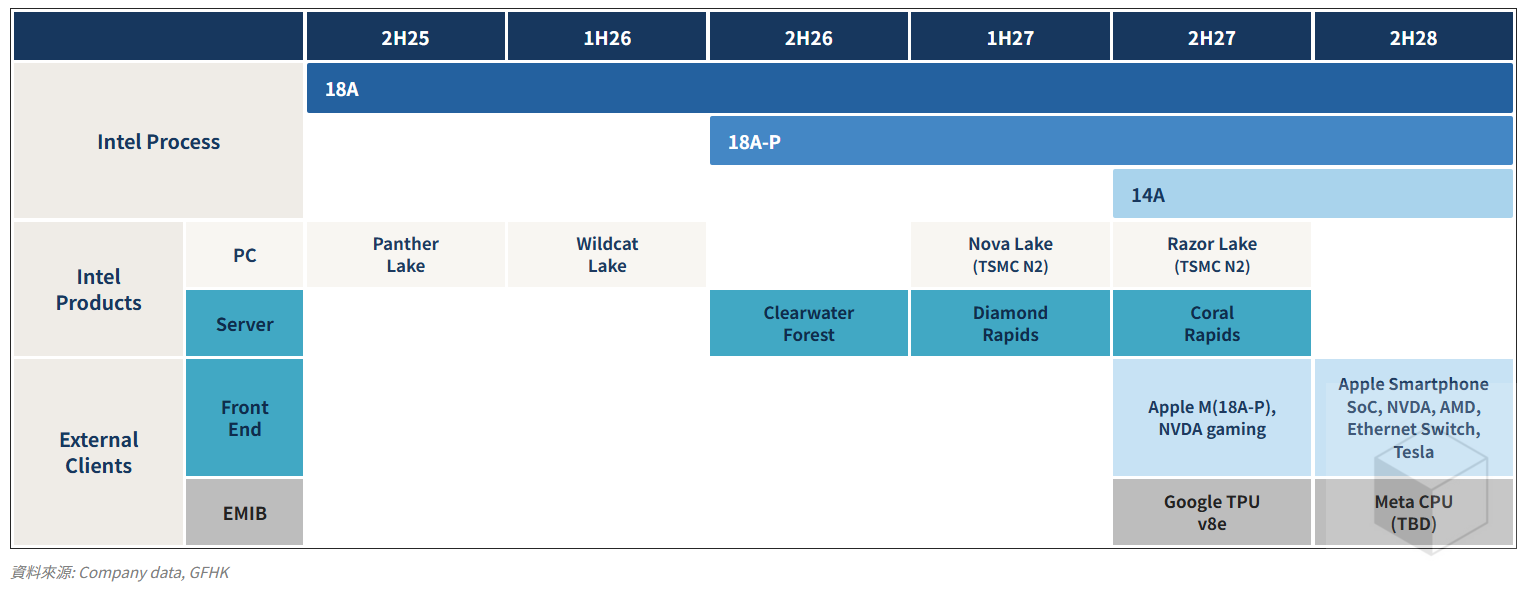
Foundry is picking up speed: our channel check , 18A yields are running above internal targets; Panther Lake yields are around 80%, in line with expectations; and 18A-P has now entered risk production too. We see 18A-P hitting risk production as a key inflection point — it's a genuinely competitive option for external customers (think the Apple M series).
14A timeline is now clear: PDK (that's the Process Design Kit) 0.9 lands around October for pre-volume, with risk production plus external-customer volume in 2H28.
The chart below is some of our own guesswork on Intel's future customer lineup.
They're pushing 2026 capex hard to >$20B, with 2027 higher still. Management expects to turn profitable in 2H27 (on the back of yields plus scale).
Intel also announced an extra €5B to expand Xeon 6 on Intel 3 (even as 18A-P is already ramping), which points to capacity being tight and Intel acting as the swing producer. The Bowers campus is also adding Mask Operations.
Google
This one already has plenty of KOLs covering it, so I won't go too deep into the financials. We read through everyone's takes, and the market seemed caught off guard by the negative FCF — but we'd argue that's actually a lagging indicator.
Our view, from a long-term standpoint, is that in the AI era software has taken on a manufacturing-like character — it's been "manufacturing-ized." In the old days, adding more usage cost almost nothing; now more usage means more token cost, just like COGS in manufacturing. So as Google shifts from being more of a software/services business toward a manufacturing one, negative FCF is no surprise!
It's not unusual for a manufacturer to swing to negative FCF when there are good growth opportunities to invest in — TSMC has had negative FCF too. So whether or not you like Google leaning more manufacturing is one thing, but negative FCF while there are investment opportunities is nothing to be alarmed about.
The single most important metric to watch in GOOG's results is the growth rate of the Google Cloud Platform (GCP) segment. Here's why: GCP's YoY growth is currently the most important pillar supporting GOOG's valuation.
Google Cloud is now a solid S-curve business — revenue keeps accelerating, up to 82% YoY, which is six straight quarters of accelerating YoY growth. OPM has also kept improving QoQ, edging toward 40%.
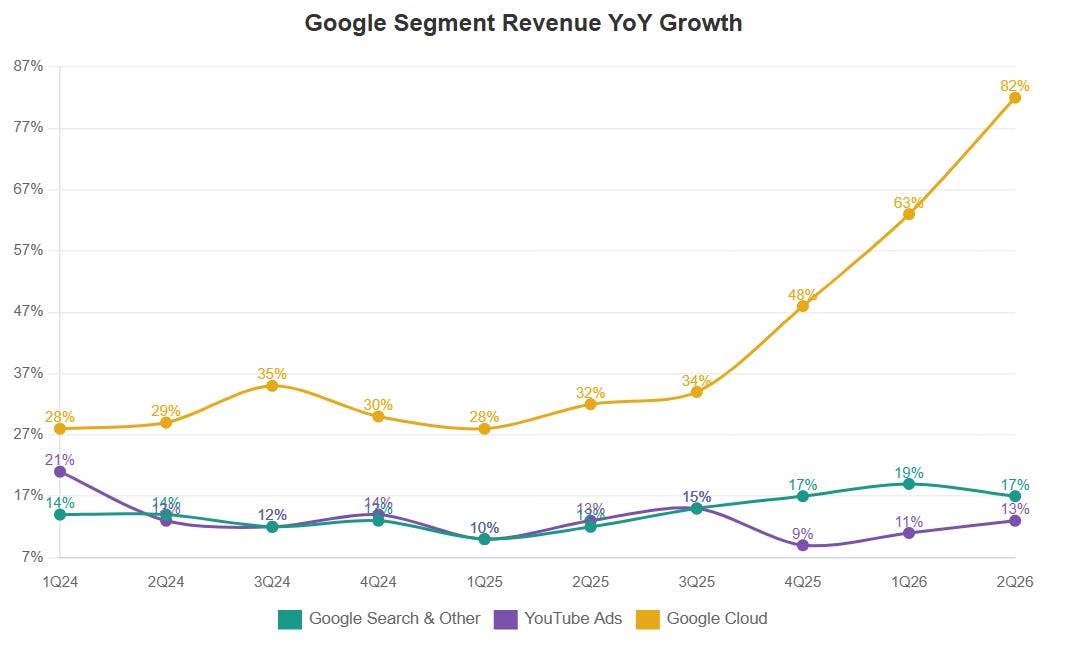
Looked at on a marginal/incremental basis, the YoY/QoQ incremental OPM comes in at 46%/54% — both well above the current ~35% level. That tells us Cloud's OPM still has scale effects left to unlock. If the incremental margin holds around 50%, OPM has a real shot at pushing above 40%, closing in on the 45% of the core Google Services business.
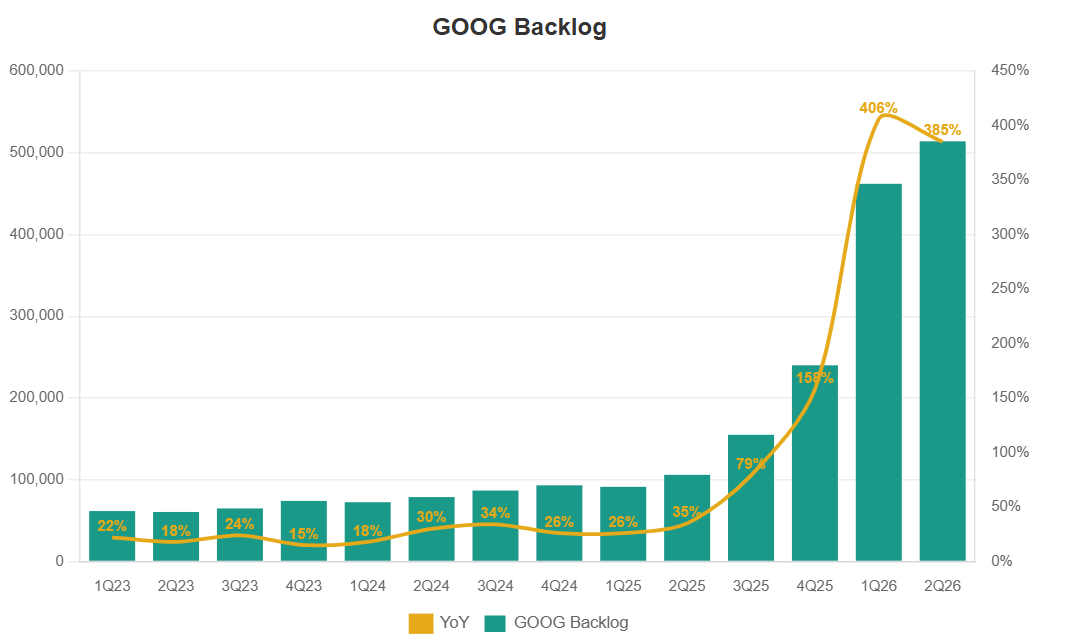
On the backlog: keep an eye on how a slowing YoY growth rate can compress the valuation. It hit $514B at the end of 2Q26 (vs. an expected $488B, a beat of roughly $26B); QoQ that's $462B → +$52B, +11% (1Q went from $240B → $462B, nearly doubling), with a bit over 50% to be recognized within 24 months.
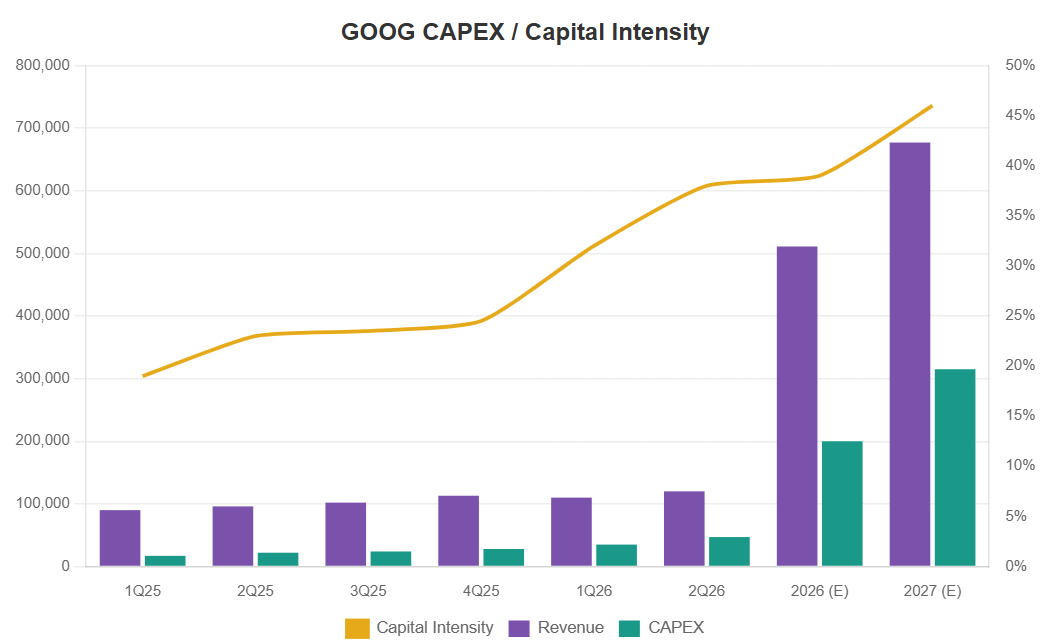
On capital intensity: based on the midpoint of $200B in capex guidance, we expect GOOG's capital intensity to keep climbing through 2026–2027, landing around 40% and 45% respectively, though it likely peaks in 2027. Management keeps stressing that 2027 capex will expand meaningfully again over 2026, which hints that the odds of a 2027 FCF recovery are shrinking — pushing the timing of GOOG's FCF recovery closer to 2028.
TXN
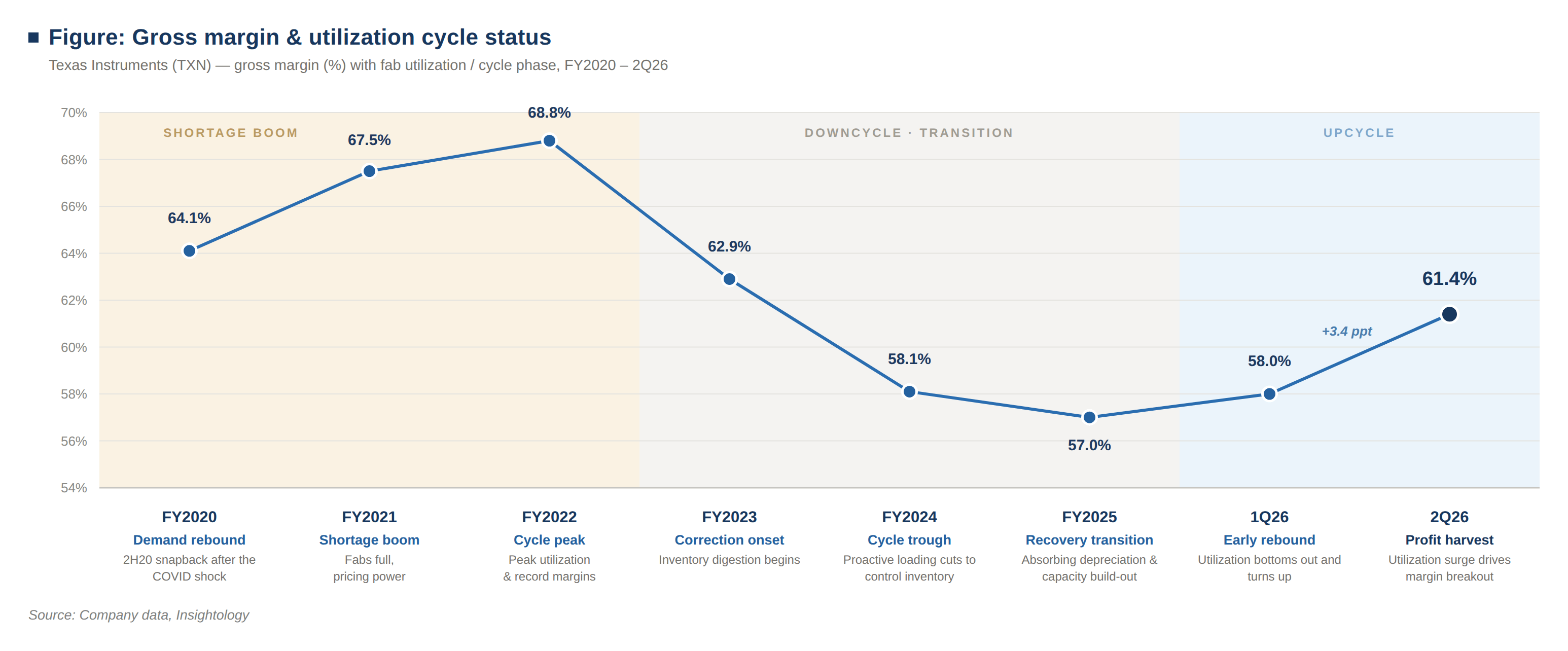
This company doesn't get nearly as much buzz in the market, but we think it's the one that most deserves the time to dig into. TXN is about to enter its "harvest" phase for profits. Unlike the other CSPs, over the past two to three years — right through the semiconductor downcycle — TXN went against the grain and poured a ton of capex into building out its 300mm (12-inch) fabs. The cleanrooms and capacity are already fully in place.
Now that TXN's capex is contracting sharply, free cash flow (FCF) is set for an explosive ramp. In today's environment, where so many tech giants are still spending like crazy on capex, TXN's FCF expansion looks genuinely scarce and pretty compelling.
we do have cleanroom space available that we can equip and ramp, so we can support a wide range of scenarios from a customer demand standpoint. - Haviv Ilan
Utilization recovery and margin repair: for an IDM (integrated device manufacturer) of this scale, the things to watch closely are "days of inventory" and the "utilization rate." Over the past few quarters, TXN kept utilization low to manage inventory, which meant heavy depreciation costs badly eating into gross margin. If demand is now broadening as they described on the call (spreading from data center into industrial and automotive), utilization will gradually climb, which brings down per-unit production cost and drives a strong margin recovery over the next few quarters.
Higher power-IC content value driven by AI data centers: TXN doesn't sell AI compute chips (GPUs/ASICs), but AI servers draw enormous amounts of power and need more — and higher-end — power management chips (power semis). Traditional servers may only need so many analog chips, but the power-architecture upgrade in AI data centers gives TXN's power management and analog products a brand-new tailwind where both volume and price rise together.
Now in the longer term, and that's going to take some time once we have the SST established, data center input will be at a DC voltage of 800 volts. And then I envision maybe direct conversion from 800 directly to 12 or 6 volts. And -- but that's coming later. And this is where the TAM continues to show strength. The higher voltage, the more opportunity we see.