

Life
I’ve recently been learning how to play bridge with friends. The last time I played bridge intensively was back in high school, and coming back to this game as an adult has given me deeper reflections. What makes bridge so fascinating is that you reason (through bidding) without being able to see all the cards, and you exchange information through bidding—while at the same time both your opponents and your partner learn your information. Beyond calculating probabilities, you also have to work with your partner’s bidding habits and read your opponents’ thinking. Even if you have good cards, you won’t necessarily win. What’s different from Texas Hold’em is that bridge requires more cooperation—you have to build trust with the partner across from you, and much of the information communication is transparent. Texas Hold’em, on the other hand, is more about individual gaming, where information is hidden not only in betting patterns but also in facial expressions and timing.
Buffett is also famously fond of bridge. Beyond both requiring you to infer the underlying truth from limited clues (bidding, card play, market signals, financial statements), bridge rewards those who consistently make correct decisions across a long series of many hands, rather than those who play the hero on a single lucky hand. Although luck heavily influences any single hand, skill emerges over the long run. And because bridge is a partnership game, you have to set aside individual heroism and coordinate with and trust your partner through a limited shared language.
Market
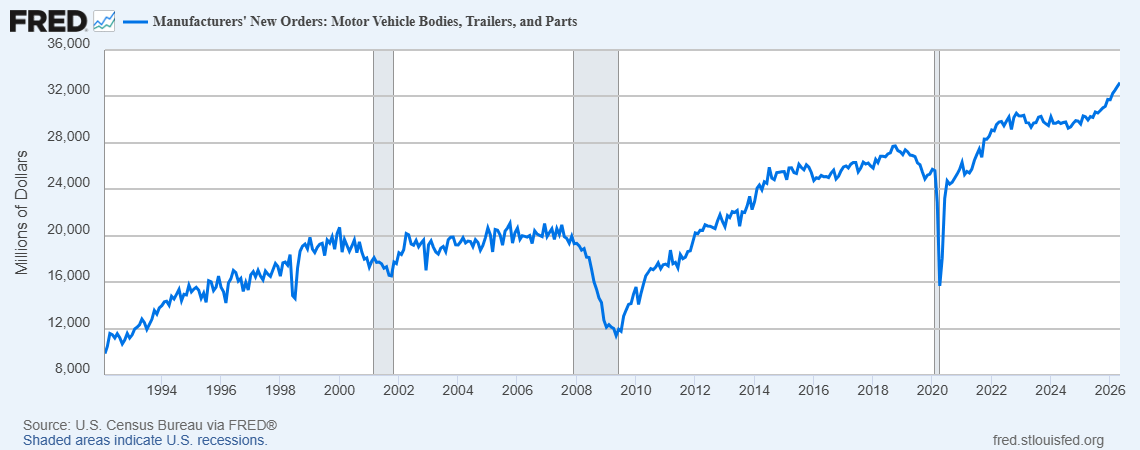
Besides AI, the U.S. auto market has been one of the very strong industries over the past few months.
Looking at new orders for Motor Vehicle Bodies, Trailers, and Parts from the latest U.S. Census Bureau M3 survey, not only did the value of new orders reach a record high, but the YoY figure also rose close to double digits. Over the past 10 months, 9 had positive month-over-month growth, showing strong continuity of momentum. The reason behind this is precisely one of the results of last year’s “tariffs.”
If we break down the underlying data more carefully, we find that the reason new order values hit record highs is because of【price increases】rather than【volume increases】. Behind the price is actually the tariff surcharge. After the 25% Section 232 tariff was imposed on imported parts, Tier-1 suppliers resold the tax-inclusive sub-assemblies onward, and the tariff amount directly inflated the shipment value.
Judging from the earnings calls of major automakers and ODMs, U.S. automakers have gradually begun localizing assembly and procurement. The M3 survey measures shipments of U.S.-based manufacturers. The 25% Section 232 made imported parts structurally more expensive, and OEMs’ response was not to shrink procurement but to shift procurement from plants in Mexico, Japan, and Korea back to U.S. plants—for example, GM will raise its U.S. capacity to over 2 million vehicles starting next year.
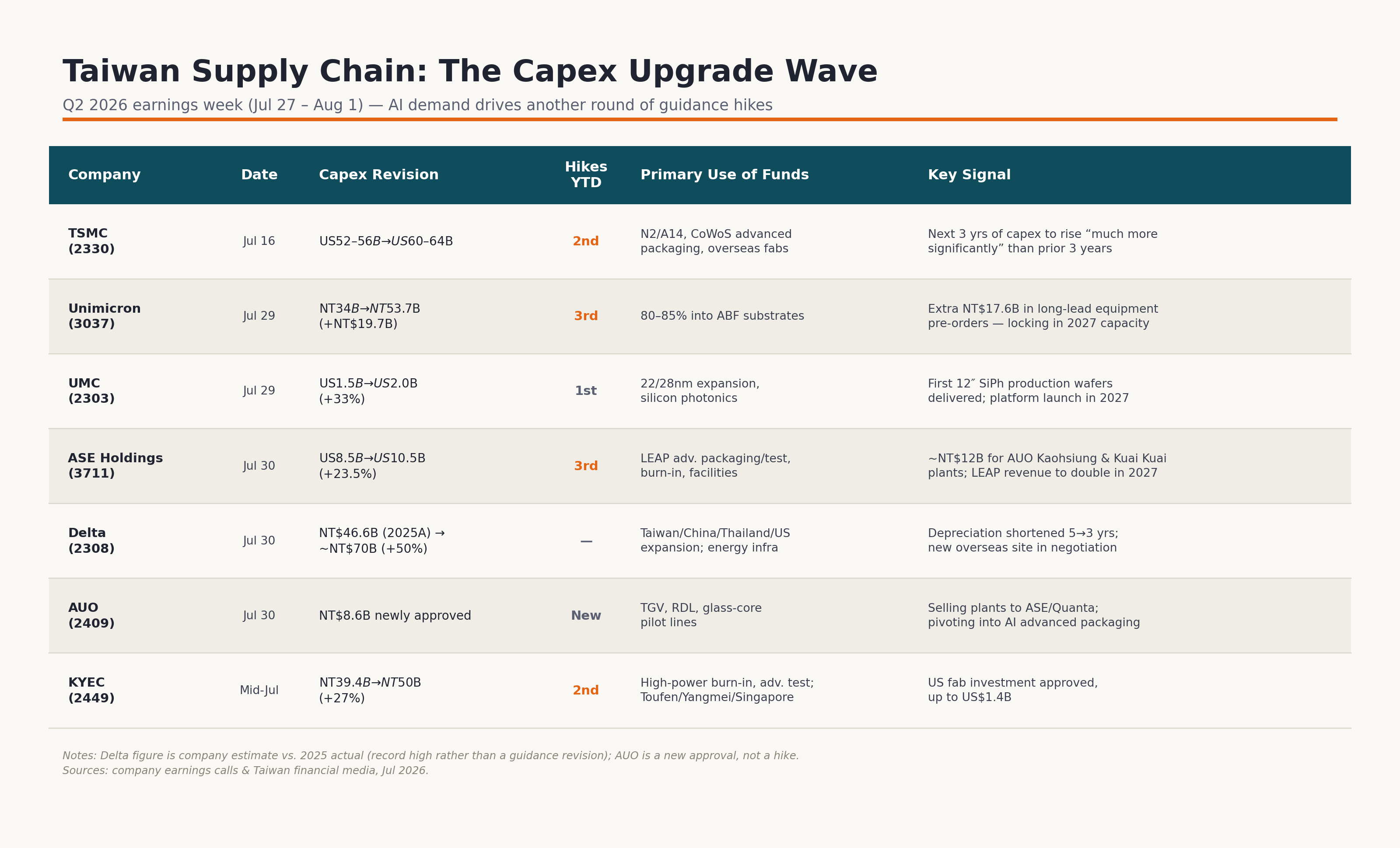
Taiwan supply chain companies raise their capital expenditure
ASE Technology Holding (3711) — 7/30 earnings call, third upward revision this year
2026 capex revised up to about $10.5B (from $8.5B), the second upward revision this year, the largest scale in its history, with funds split roughly evenly between plants and equipment. It also purchased AUO’s plant (NT$6.3 billion) and land/plant (NT$5.67 billion). ASE views glass substrates and silicon photonics as the key to breaking through hardware bottlenecks, and capex is very likely to be directed toward LEAP.
Delta Electronics (2308) — 7/30 earnings call
Capital expenditure this year will increase to about NT$70 billion, up roughly 50% from last year’s NT$46.6 billion, with continued plant expansion in Taiwan, China, Thailand, and the U.S. The second half looks better than the first half. 800V DC equipment begins mass production in Q3, but shipments before year-end will be limited, with the real large-scale shipments coming next year. The company also mentioned it has begun shortening the depreciation period for related equipment from 5 years to 3 years, so that if a project changes, risks can be reflected more quickly—it can’t wait for orders to arrive before building plants.
Unimicron (3037) — 7/29 earnings call, third upward revision this year
The board resolved to increase 2026 capital expenditure from the originally planned ~NT$34 billion by NT$19.7 billion to NT$53.7 billion, and simultaneously increased the booking amount for long-lead-time equipment by NT$17.6 billion. Of this, as much as 80% to 85% is focused on ABF.
UMC (2303) — this week’s earnings call
Raised 2026 capital expenditure from the original $1.5 billion to $2 billion (+33%), a rare significant increase for a mature-process foundry. 22/28nm continues to hit record highs, capacity utilization returned to 85%, and this month it completed delivery of its first batch of 12-inch silicon photonics mass-production wafers, with plans to launch a silicon photonics platform available to more customers in 2027.
Quanta: Raised up to $2.2B (NT$71.2 billion) via GDS in Luxembourg, the largest overseas fundraising by a Taiwanese company in nearly 20 years, used for building plants and procuring component materials.
AUO : Investing NT$8.64 billion ($267M) in capex to build a FOPLP glass substrate advanced packaging pilot production line. The three core technologies are Glass Core, RDL, and TGV, with applications targeting LEO satellite antennas, Micro LED, and optical communications.
King Yuan Electronics / Ardentec: NT$28.5 billion ($880M) to expand advanced testing capacity in Longtan .
Linde: Investing $1 billion in Arizona to supply ultra-high-purity nitrogen, oxygen, and argon to two new fabs; its Taiwan joint venture is separately investing $800 million to supply the same customer’s new plant in Taiwan (presumably TSMC).
Insightology View:
This week, besides major players Microsoft, Amazon, and Google successively announcing upward revisions to capital expenditure, Taiwanese supply chain companies also announced continued upward revisions to capex, with many making their second or third revision within the year. Overall, the entire capex cycle has already spread from the wafer end to packaging and testing, power, passive components, panel makers pivoting to packaging, and further upstream to industrial gases.
A long-term warning signal from European interest rates
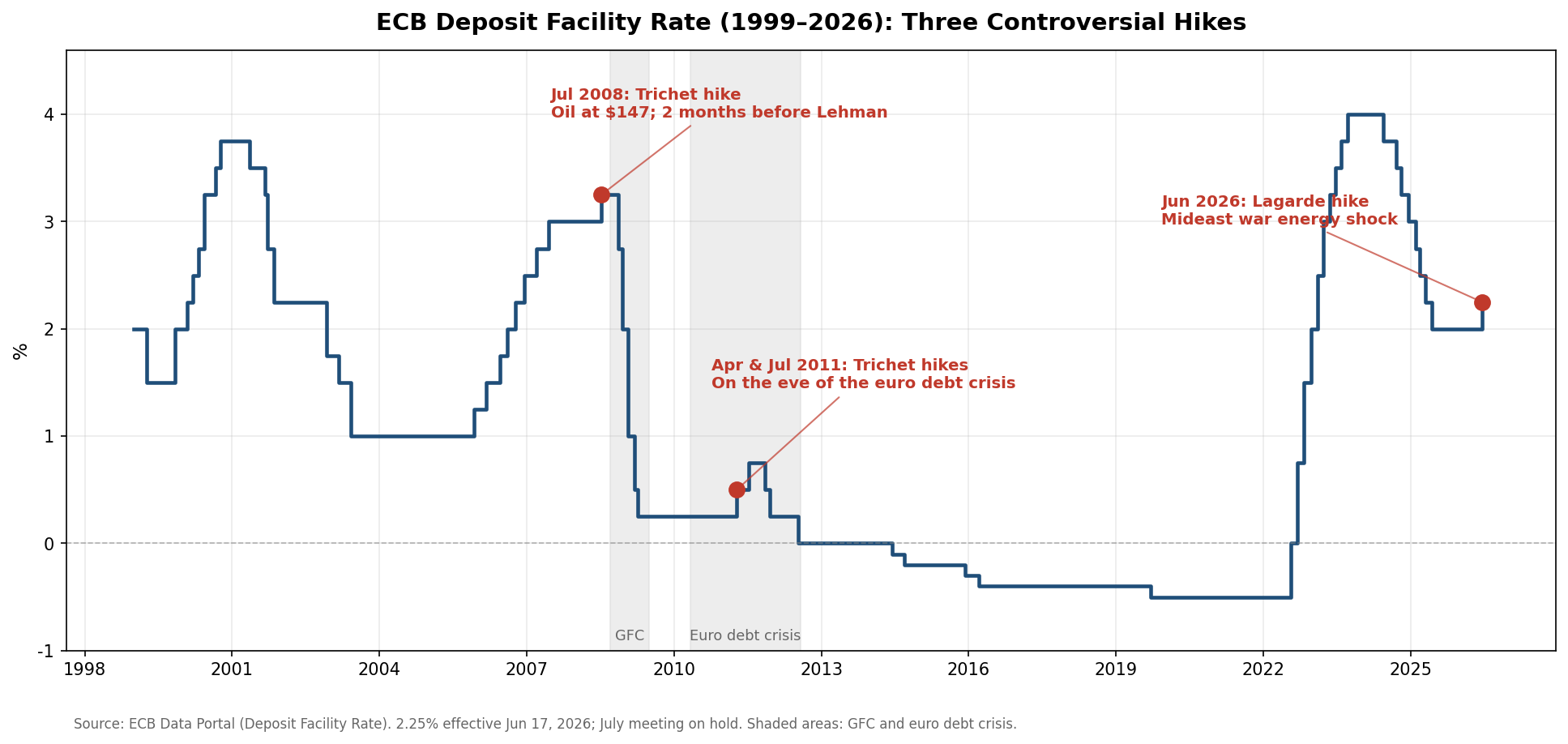
This is a topic that fewer people in the market mention. In this round of interest rate decision meetings across countries, Europe announced on June 11 that its three key rates would each rise by one quarter-point. Effective June 17, the main refinancing rate, deposit facility rate, and marginal lending rate reached 2.40%, 2.25%, and 2.65% respectively—the first rate hike in nearly three years (since September 2023).
To me this is quite a warning sign, reminding me of Trichet’s rate hike in July 2008. Back then, the EU also hiked rates during a European economic downturn, and likewise hiked due to exogenous cost pressures. It also showed the same policy divergence with the Fed. And now Europe’s economic resilience is not what it was before 2008. If in the future the U.S. begins to see a cyclical slowdown in capital expenditure and the global economy cyclically slows, then EU policy may well be one of the straws adding fuel to the fire.
On risk management & leverage
The biggest news this week was the Situational Awareness (Leopold Aschenbrenner) deleveraging event, in which Citadel took over his stock book at an undisclosed discount.
When it comes to risk management in the markets, if past experience can tell us anything, it’s that when most people feel very “safe” and think they can apply historical experience to how the market works every time, that kind of thinking is extremely dangerous. Because market corrections have never promised to stop only after prices rise or fall to some specific multiple of the PE ratio.
This time, semiconductor supply chain-related stocks in the U.S., Korea, Taiwan, and elsewhere all rose enormously, and many young “stock gods” made a lot of money from this wave (many friends around me saw their net worth jump very quickly in June while still under thirty). But if leverage is used incorrectly, the scariest thing is that it will amplify some extreme event to the point of knocking you out or wiping you out to zero. In every major crash, I hear about different friends, or friends of friends, whose assets came very close to zero—and this time was no exception. Just like the passage from Munger quoted in Berkshire’s 2022 annual report often uses an analogy: a string of beautiful investment return numbers, once multiplied by a single “zero” somewhere in the middle, ends up as zero.
There is no such thing as a 100% sure thing when investing. Thus, the use of leverage is dangerous. A string of wonderful numbers times zero will always equal zero. Don’t count on getting rich twice.
— Charlie Munger, as compiled in Warren Buffett’s 2022 shareholder letter
The cycles of stock prices and fundamentals move at different speeds—one fast, one slow—and combining them while expecting good short-term results is inherently quite difficult. Leverage lowers your margin for error even further. And in my experience, the higher someone’s IQ—even very smart people—the more they tend to misuse leverage, believing it can accelerate wealth accumulation, but often being unable to control its destructive power when it works in reverse.
History tells us that leverage all too often produces zeros, even when it is employed by very smart people.
— Warren Buffett, 2010 shareholder letter
The grandfathers’ wisdom is still very useful!