


Life
For Thanksgiving, we’re spending the week in Denver with friends. We chose to road trip from Austin to Denver, driving from the vast, almost barren plains of Texas to the hilly terrain of Colorado. What I’m most curious about is the people who live here—I wonder how they spend a typical, ordinary day.
Calling all locals! 📣 If you were raised here, please share your top recommendations for the most interesting and must-do things in Colorado.
Market:
GOOG Releases Gemini 3.0 Pro – Our Thoughts
From a technical standpoint, we believe the core success of Gemini 3.0 Pro lies in the extreme execution of Scaling Laws and significant innovations in the underlying model architecture.
Gemini 3 implements Model-Native Multimodality, mixing data across different modalities (text, image, video) during pre-training. Its reasoning mechanism adopts a Tree of Thoughts (ToT) architecture, allowing the model to process multiple lines of reasoning in parallel internally. It validates and selects these paths through a self-rewarding mechanism, significantly improving accuracy. Furthermore, the model utilizes an engineering wrapper for Environment Engineering to provide feedback validation, continuously breaking through performance bottlenecks. This is where we see a distinct technical divergence from previous models.
Additionally, for developers, Google launched the Antigravity IDE. Leveraging Gemini 3 Pro’s Browser Use capabilities—which scored highest in Screenshot Pro benchmarks—it achieves fully automated frontend development and testing.
However, testing with friends revealed that Gemini 3’s performance in Real World Visual Understanding (such as security camera scene analysis) has actually declined. Simultaneously, feedback suggests that for complex tasks involving repeated multi-hop external searches and information synthesis, its performance may still lag behind ChatGPT Pro.
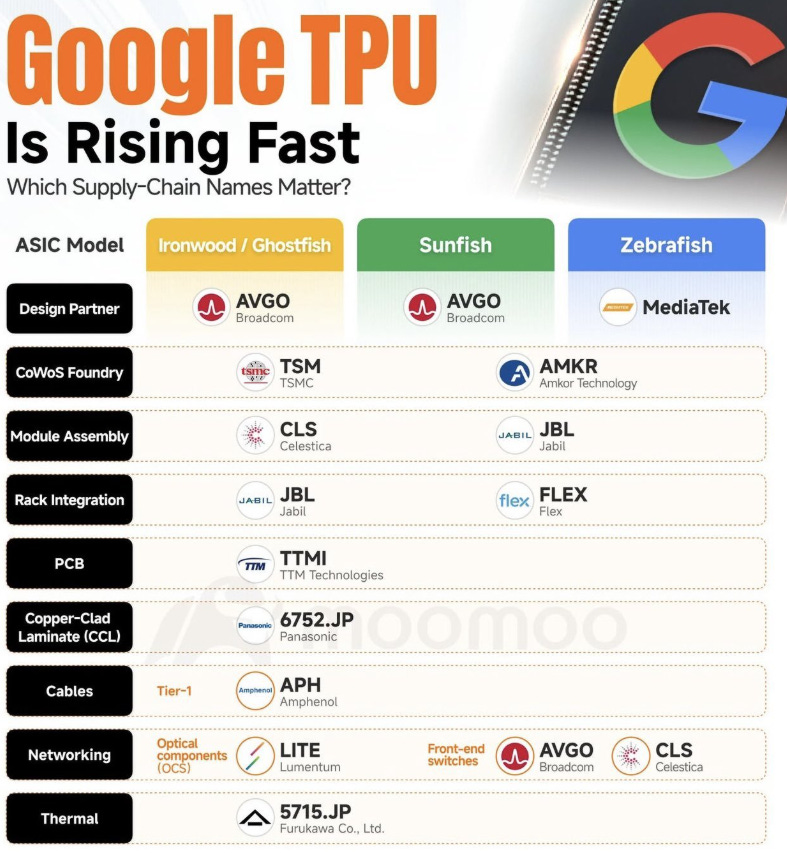
We believe GOOG retains an economic advantage in hardware. The key to Google’s successful execution of Scaling Laws is the integration of its TPU software and hardware. Compared to companies lacking proprietary hardware capabilities—who must absorb NVIDIA’s high profit margins—Google possesses a distinct economic advantage in executing large-scale Scaling Laws.
This release has strengthened my confidence in GOOG and its supply chain, including CLS, LITE, and Taiwan-based companies like Guang Sheng (FOIT).
The Netscape Déjà Vu
The launch of Gemini 3 triggered a sudden realization. We’ve seen this movie before. The precedent has been staring us in the face the whole time: Netscape.
For those who might be too young to remember, Netscape was the OpenAI of the 90s. They built the first browser that truly took off, single-handedly ushering the world into the internet age. They were powerful, adored, and looked invincible.
But we know how that story ended.
Netscape proved that humans had a massive demand to “go online.” But then Microsoft—the incumbent giant—woke up. They bundled Internet Explorer into Windows for free. It was the kiss of death. Despite Netscape’s IPO war chest and desperate attempts to build a moat, they couldn’t compete with “free” and “default.”
Today, the board is set up exactly the same way.
OpenAI is Netscape: The pioneer who opened the door.
Google is Microsoft: The giant with the unfair distribution advantage.
Google isn’t just a software company; they possess an economic advantage that OpenAI cannot match. They have self-developed TPUs (meaning rock-bottom inference costs compared to paying the “NVIDIA tax”), billions of users locked into Gmail and Maps, and a massive Cloud infrastructure for enterprise.
Just as Microsoft used Windows to win the browser war, Google is now bundling Gemini into its ubiquitous ecosystem to squeeze OpenAI out.
The Momentum Shift Crucially, the one thing keeping OpenAI alive—ChatGPT’s superior performance—is slipping. With Gemini 3 now pulling ahead in benchmarks, investors have little reason to keep buying OpenAI’s pitch that they just need “more money to reach AGI first.”
So, is AI a bubble? If you look at history, the answer isn’t Yes or No—it’s “Yes, but...”
The Dotcom bubble popped, and companies vanished (RIP Netscape), but the internet infrastructure remained. It paved the way for today’s Big Tech.
We are likely heading toward a similar endgame:
The Pioneer Bubble: OpenAI, the frontrunner, risks popping or fading away like Netscape.
The Infrastructure Boom: The massive capex spending is real. We are building the rails for the next generation of intelligence.
This means hardware and infrastructure companies still have a long runway of good times ahead. That part isn’t a bubble.
OpenAI kicked off a war they might not finish. They cracked open the door to a new world, but it looks like Google is the one rushing in to conquer the territory.
Whatever happens, it’s been a Good Game. But right now, those two G’s stand for Google.
Insightology View : Rethinking the ROI Panic
I recently watched Nana Banana Pro successfully generate Traditional Chinese text for the first time—instantly creating finished product ads. Between this and the release of Gemini 3 Pro, we aren’t just seeing an update; we are witnessing a massive generational leap.
This progress has forced me to re-evaluate the skepticism that has dominated the market over the last two weeks.
Investors have been stressing over ROI, depreciation, and the path to monetization. The fear was that revenue wasn’t taking off. But let’s look at the root cause:
Revenue was flat because applications were stagnant.
Applications were stagnant because the base models weren’t good enough.
There was a capability bottleneck.
Now that we see base models smashing through those ceilings, the bottleneck is clearing. Better foundational models will unlock new software capabilities and use cases, which in turn will drive the revenue growth everyone has been waiting for. The anxiety surrounding ROI and monetization is likely to alleviate as these new capabilities hit the market.
The takeaway: We are still in the rapid-growth phase of foundational models. It is a mistake to let today’s restrictive financial models limit our imagination for what’s coming next.
Book : Rewire: Break the Cycle, Alter Your Thoughts and Create Lasting Change
In the process of researching AI, I feel like I am researching how the human brain works. This week, I finished reading Rewire, and it gave me a lot of inspiration.
In the AI era, software tools have become more convenient and the barriers lower. Building a website, writing an article, creating a service, or building a brand is incredibly fast today. However, I want to reverse the focus and understand more deeply how our brains function, and how to use AI to achieve a better balance in life and work.
Especially as new AI tools are released daily, I feel that while absorbing this information, my brain is slightly overworked. This fueled my curiosity about how to effectively manage emotions, brainpower, and the body. Starting from within, once the core is stable, I believe we can handle external information changes with more ease.
The book mentions several exercises I’ve been trying recently:
The Physiological Sigh: This is a breathing technique to quickly regulate the nervous system, known as “cyclic sighing.” It artificially accelerates the process of returning to calmness. It has been proven to be the most effective way to immediately return you to a parasympathetic state (rest and digest). The Method: Inhale twice consecutively, then exhale slowly. The double inhale is crucial because it forces collapsed alveoli (air sacs) to pop open and re-inflate. This effectively removes excess carbon dioxide from the system, as high CO2 levels cause feelings of stress and agitation. Essentially, it sends a safety signal to the brain, telling the body, “I am no longer facing any threat.” I have physically felt my heart rate drop and return to a relaxed state.
Deliberate Disconnection: Avoiding the internet specifically at the beginning and end of the day. The book cites this as a key strategy to protect “brain hardware” and avoid cognitive overload. Now, for the first 30 minutes after waking up and the last hour before bed, I don’t use my phone. I’ve found that not replying to messages instantly or checking social media hasn’t impacted my life negatively; in fact, I feel better, and I work more efficiently. When people are tired and mentally drained, they rely on mental shortcuts, regressing to automatic and rigid states. Strategic Rest (like staying away from screens) allows the brain to recharge, avoiding the old patterns of rumination, binge-eating, or doom-scrolling.
Journaling Before Bed: I used to think journaling was a waste of time. But since swapping scrolling time for journaling and reading, my anxiety regarding information has actually decreased. The book notes that journaling helps reduce emotional burdens and the frequency of ruminating thoughts. When journaling, we must use complete sentences, which differs from the disorganized state of rumination. Writing guides thoughts toward something more cohesive, organizing them so they don’t run wild without a beginning or end. Activating the Logical Brain: Journaling activates the areas of the brain related to speech generation, requiring the use of the frontal cortex (the logical thinking part). This mobilizes the rational part of the brain, preventing the emotional limbic brain from taking charge. Externalizing and Managing Thoughts: Through writing, we externalize ruminating thoughts, making them manageable. This allows you to face your thoughts and feelings in a controlled environment, lightening the emotional load.
These are simple things, but repeating them consistently every day is not easy—breathing, sleeping, writing. Although difficult, they are far more important than researching new tech or following KOLs every day.-Insightology Research
What I Read
https://simonwillison.net/2025/Nov/18/gemini-3/

Transcript
Nvidia Earnings Call Transcript
KLIC Earnings Call Transcript
Books
Excellent analysis of Gemini 3.0 Pro, it's fascinating to read such a detailed technical deep dive into its arhitecture. I'm especially intrigued by the Model-Native Multimodality and the Tree of Thoughts approach; do you think these design choices will become industry standard moving forward? Your insights truly make complex topics accessible.